Sumerian math
I have always known, in a trivia-fact sort of way, that we got 60-minute hours and 360-degree circles from ancient Mesopotamia. I had never actually sat down to do arithmetic in base 60, though, until I fell down a rabbit hole reading about Sumerian and Babylonian clay tablets and ended up building sumerian-math, a pure JavaScript base-60 engine paired with an interactive 3D scribal workshop (É-dub-ba-a).
The fastest way I know to really understand a system is to implement it. Once I started writing the conversion routines, reciprocal tables, and tablet visualizers, base 60 stopped feeling like a historical curiosity and started feeling like a remarkably well-designed numeral system for its time.
Why base 60 worked
Base 10 is an accident of anatomy. Ten only divides cleanly by 1, 2, 5, 10,
which means even basic everyday splits (cutting something into thirds,
quarters, or sixths) immediately produce awkward or repeating decimals
(0.3333..., 0.1666...).
Sixty has twelve divisors: 1, 2, 3, 4, 5, 6, 10, 12, 15, 20, 30, 60. If you
are a Mesopotamian scribe dividing barley rations, silver weights, land
allotments, or workdays, almost every fraction you touch terminates cleanly:
| Fraction | Base 10 | Base 60 |
|---|---|---|
| 1/2 | 0.5 |
0;30 |
| 1/3 | 0.3333... |
0;20 |
| 1/4 | 0.25 |
0;15 |
| 1/5 | 0.2 |
0;12 |
| 1/6 | 0.1666... |
0;10 |
| 1/12 | 0.0833... |
0;05 |
In modern academic notation, integer base-60 places are separated by commas and
the fractional part starts after a semicolon, so 2;45 means 2 + 45/60 = 2.75.
Two wedges and positional notation
What surprised me most when building the tablet inscription mode was how minimal the physical encoding is. Scribes did not need 60 distinct symbols. With a single reed stylus pressed into wet clay at two angles, they made just two marks:
- Vertical wedge (DIŠ)
𒁹= 1 - Corner wedge (U)
𒌋= 10
Inside each base-60 column (values 0 through 59), numbers are additive:
47 is four corner wedges followed by seven vertical wedges (𒌋𒌋𒌋𒌋𒁹𒁹𒁹𒁹𒁹𒁹𒁹).
Across columns, however, the system is positional, where each column to the
left is multiplied by 60:
| Decimal | Sexagesimal | Cuneiform | Breakdown |
|---|---|---|---|
| 1 | 1 |
𒁹 | 1 one |
| 23 | 23 |
𒌋𒌋𒁹𒁹𒁹 | 2 tens + 3 ones |
| 60 | 1,0 |
𒁹 | 1 in the sixties place |
| 75 | 1,15 |
𒁹 𒌋𒁹𒁹𒁹𒁹𒁹 | 1×60 + 15 |
| 3,661 | 1,1,1 |
𒁹 𒁹 𒁹 | 1×60² + 1×60 + 1 |
Notice the row for 60: for most of Babylonian history, there was no zero
placeholder and no sexagesimal point. A single vertical wedge 𒁹 could mean
1, 60, 3,600, or 1/60. Scribes inferred the scale from context, much
like working with floating-point mantissas where you keep track of the exponent
in your head. Implementing a parser and tablet grader forced me to appreciate
just how much implicit context those scribes carried effortlessly.
Division without dividing
Babylonian scribes did not do long division the way we do. Instead, they turned
division into multiplication by a reciprocal: a / b = a × (1/b).
Because the prime factors of 60 are 2, 3, and 5, any 5-smooth
(“regular”) number of the form 2ᵃ × 3ᵇ × 5ᶜ has an exact, terminating
reciprocal in base 60. In base 10, only 2ᵃ × 5ᵇ terminates, so 1/3, 1/6,
1/9, 1/12, and 1/15 all repeat forever. In base 60, every single one of
them is exact.
Scribal students memorized IGI tables of regular reciprocals (2 -> 0;30,
3 -> 0;20, 8 -> 0;07,30, 9 -> 0;06,40, 16 -> 0;03,45, and so on). When
an irregular number like 7 or 11 showed up, the tablet simply noted that it
had no exact reciprocal and used an approximation.
Two tablets that made it click
Reading about base 60 in the abstract is interesting, but modeling actual surviving clay tablets in 3D is what really drove home how capable this system was:
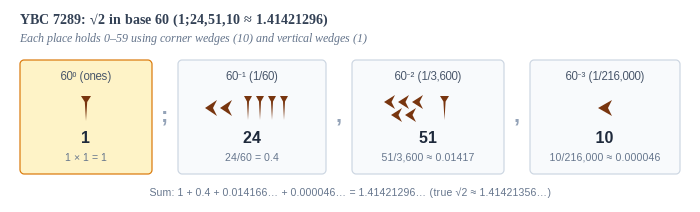
- YBC 7289 (c. 1800–1600 BCE). A palm-sized school tablet at Yale showing
a square of side
30with the diagonal ratio1;24,51,10inscribed across the middle and the diagonal length42;25,35below it. In decimal,1;24,51,10is1.41421296..., accurate to within0.0000006of√2. They arrived at it using the iterative rectangle-averaging methodxₙ₊₁ = ½(xₙ + S/xₙ)(what we now recognize as Newton’s method for square roots), which converges in just a few steps. - Plimpton 322 (c. 1800 BCE). A broken clay table listing 15 rows of exact
Pythagorean triples
(w, l, d)and their sexagesimal(d/l)²ratios, generated systematically from pairs of regular numbers(p, q)more than a millennium before Pythagoras.
I also ended up adding an earlier stage from the Uruk period (c. 3500–3000 BCE), before cuneiform existed at all. Merchants tracked grain and livestock using small clay tokens (cones, spheres, and disks) sealed inside a hollow clay ball called a bulla. To record what was inside without breaking the seal, they pressed the tokens into the wet outer surface. In a dispute, you could crack the bulla open and count the tokens directly. Over time, the impressions on flat clay replaced the tokens altogether, which is how written numerals began.
Putting all of this into sumerian-math (the sexagesimal engine, the grooved counting board, the YBC 7289 convergence visualizer, the Plimpton 322 table, and the clay-token bulla) changed how I think about numeral systems. We treat base 10 as the default. Spending a few days inside base 60 is a good reminder that number systems are design choices with real ergonomic tradeoffs, and that scribes pressing reeds into wet mud four thousand years ago made a surprisingly good one.